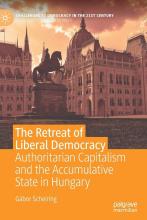
The retreat of liberal democracy : authoritarian capitalism and the accumulative state in Hungary
Scheiring, Gábor
Demokracja, Autorytaryzm, Polityka, Rząd (organ państwowy), Węgry, 2000-2099
dostępne:
1 z 1
Autor
Scheiring, Gábor
Tytuł
The retreat of liberal democracy : authoritarian capitalism and the accumulative state in
Hungary
Objętość
xxvii, 367 pages :
Rozmiary
22 cm.
Seria
Challenges to democracy in the 21st century
Hasła przedmiotowe
Demokracja
Autorytaryzm
Polityka
Rząd (organ państwowy)
Węgry
2000-2099
Informacje dodatkowe
Includes bibliographical references (pages 346-356) and index.
1. Introduction -- 2. The Political Economy of Illiberalism -- 3. The Competition State -- 4. International Integration, Domestic Disintegration -- 5. Workers and Neo-Nationalism -- 6. National Bourgeoisie and Economic Nationalism -- 7. The Accumulative State -- 8. Conclusions.
Streszczenie
This book is the product of three years of empirical research, four years in politics, and a lifetime in a country experiencing three different regimes. Transcending disciplinary boundaries, it provides a fresh answer to a simple yet profound question: why has liberal democracy retreated? Scheiring argues that Hungary's new hybrid authoritarian regime emerged as a political response to the tensions of globalisation. He demonstrates how Viktor Orbán's Fidesz exploited the rising nationalism among
020
%a 9783030487515
020
%a 3030487512
100
%a Scheiring, Gábor
245
%a The retreat of liberal democracy :
%b authoritarian capitalism and the accumulative state in
Hungary /
260
%a
%b
%c
300
%a xxvii, 367 pages :
%b illustrations ;
%c 22 cm.
490
%a Challenges to democracy in the 21st century
504
%a Includes bibliographical references (pages 346-356) and index.
505
%a 1. Introduction -- 2. The Political Economy of Illiberalism -- 3. The Competition State -- 4. International Integration, Domestic Disintegration -- 5. Workers and Neo-Nationalism -- 6. National Bourgeoisie and Economic Nationalism -- 7. The Accumulative State -- 8. Conclusions.
520
%a This book is the product of three years of empirical research, four years in politics, and a lifetime in a country experiencing three different regimes. Transcending disciplinary boundaries, it provides a fresh answer to a simple yet profound question: why has liberal democracy retreated? Scheiring argues that Hungary's new hybrid authoritarian regime emerged as a political response to the tensions of globalisation. He demonstrates how Viktor Orbán's Fidesz exploited the rising nationalism among
648
%a 2000-2099
650
%a Demokracja
650
%a Autorytaryzm
650
%a Polityka
650
%a Rząd (organ państwowy)
651
%a Węgry
Dostępne egzemplarze
1.
Numer inwentarzowy: 9458
Sygnatura: 12.4 Europa Środkowa
Sygnatura: 12.4 Europa Środkowa
Status: Do wypożyczenia